Practical ideas for freight operations.
Guides on AI, automation, and the work that keeps shipments moving.

Automating Customer Shipment Updates Without Losing the Personal Touch
Automate customer shipment updates with current information, clear sending rules and human follow-up. A practical guide for freight forwarding teams.
Read article →
How to Scale a Freight Forwarding Business Without Overloading Your Team
Scale your freight forwarding business with a practical capacity plan. Reduce repeated work, improve handoffs and manage exceptions before adding shipment volume.
Read article →
Freight Forwarding Sales Strategies for 2027: Win the Right Shippers
Build a freight forwarding sales plan for 2027: target the right shippers, improve quote follow-up, win first bookings and grow profitable repeat business.
Read article →
Best AI Tools for Freight Forwarders in 2026: A Q4 Buyer's Guide
Compare AI tools for freight forwarders by workflow, integration and human control. Build a practical Q4 shortlist and test it before committing.
Read article →
Shared Inbox Management for Freight Teams: From Triage to Done
Organize freight operations emails by shipment, assign owners, set response targets and use rules or AI to handle routine work with clear review paths.
Read article →
AI Agents for Logistics: What They Actually Do in a Forwarder's Inbox
Learn what AI agents can do in freight forwarding, how they differ from chatbots and RPA, and what to test before trusting them with operational work.
Read article →
Freight Invoice Automation: Matching Carrier Invoices to the Right Shipment
How forwarders automate carrier invoice capture and shipment matching, check costs and duplicates, and review US demurrage and detention billing requirements.
Read article →
Telex Release Explained: How It Works and When Forwarders Use It
What a telex release is, how it works step by step, how it differs from an original bill, a surrendered bill and a sea waybill, and what forwarders should check.
Read article →
ISF Filing (10+2): A Forwarder's Checklist to Avoid Late Penalties
ISF filing explained for forwarders: the 10+2 data elements, the 24-hour pre-lading deadline, who is responsible, how updates work, and when CBP may issue $5,000 liquidated-damages claims.
Read article →
Demurrage vs Detention: The Difference, Who Pays, and How to Track Both
Demurrage vs detention explained: where each charge applies, when the clock starts, who usually pays, how per diem fits in, and how to track both on every container.
Read article →
How to Pilot an AI Teammate in a Freight Forwarding Team in 2–4 Weeks
A practical 2–4 week plan to pilot an AI teammate in a freight forwarding team: readiness checks, choosing the workflow, week-by-week steps and what to measure.
Read article →
Arrival Notice in Shipping: What It Includes and What Happens Next
What an arrival notice is in shipping, who sends it, what it includes, how it differs from a delivery order, and what a forwarder should do when one arrives.
Read article →
Logistics Email Automation: A Practical Guide for Freight Ops Teams
A practical guide to logistics email automation: the three levels, which freight emails to automate first, the guardrails to set, and a 30-day rollout plan.
Read article →
What Is Last Free Day (LFD) in Shipping, and Why Missing It Costs So Much
LFD means last free day: the final day a container can leave the terminal before demurrage starts. Learn how it's set, why it moves and how to track it.
Read article →
Demurrage Charges: What They Are and How Freight Forwarders Avoid Them
What demurrage charges are, why they happen, who pays, how US billing rules work, and the practical steps freight forwarders use to avoid them.
Read article →
The Ocean Import Process, Step by Step: From Pre-Alert to Delivery
Follow an ocean import shipment from ISF and pre-alert to arrival notice, customs, release, pickup and empty return, and see where the work and the risk sit.
Read article →
AI in Freight Forwarding: From Analytics to an AI Teammate That Does the Work
How AI is used in freight forwarding today, from analytics and AI tools to AI teammates that read the inbox, complete routine work and escalate exceptions.
Read article →
Freight Data Entry Automation: What Zero Manual Re-Entry Actually Requires
See how freight data entry automation reduces re-keying across quotes, bookings, documents, email, portals, and FMS workflows while preserving human control.
Read article →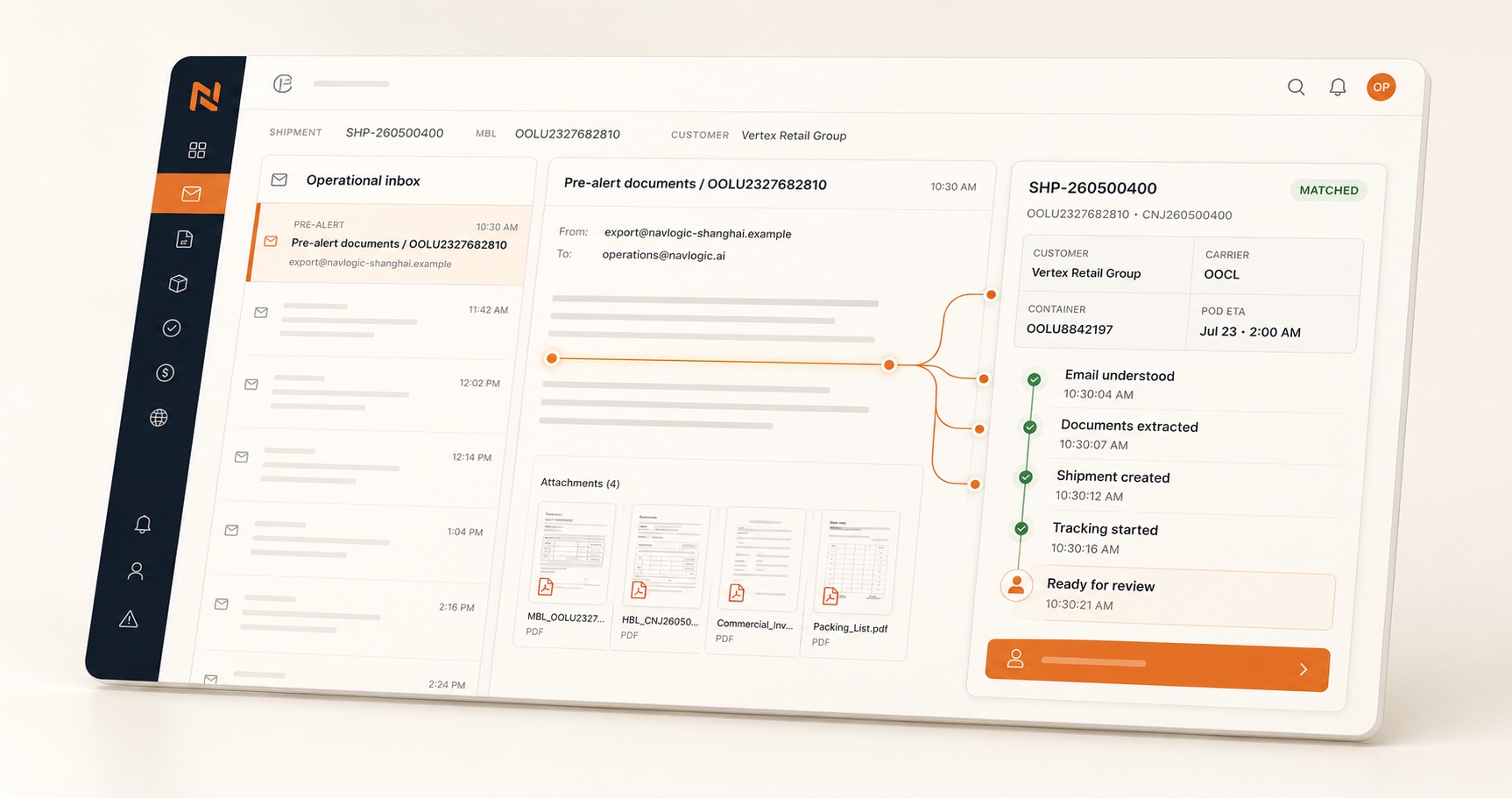
How AI Turns Freight Emails Into Operational Work
Learn how AI reads freight emails, creates and updates shipments, starts tracking, prepares documents, and flags exceptions for operator review.
Read article →
FMS vs. AI Operations Software: What’s the Difference?
Compare an FMS, a narrow automation layer, and an AI freight operations platform. Learn when AI should integrate with or become your core platform.
Read article →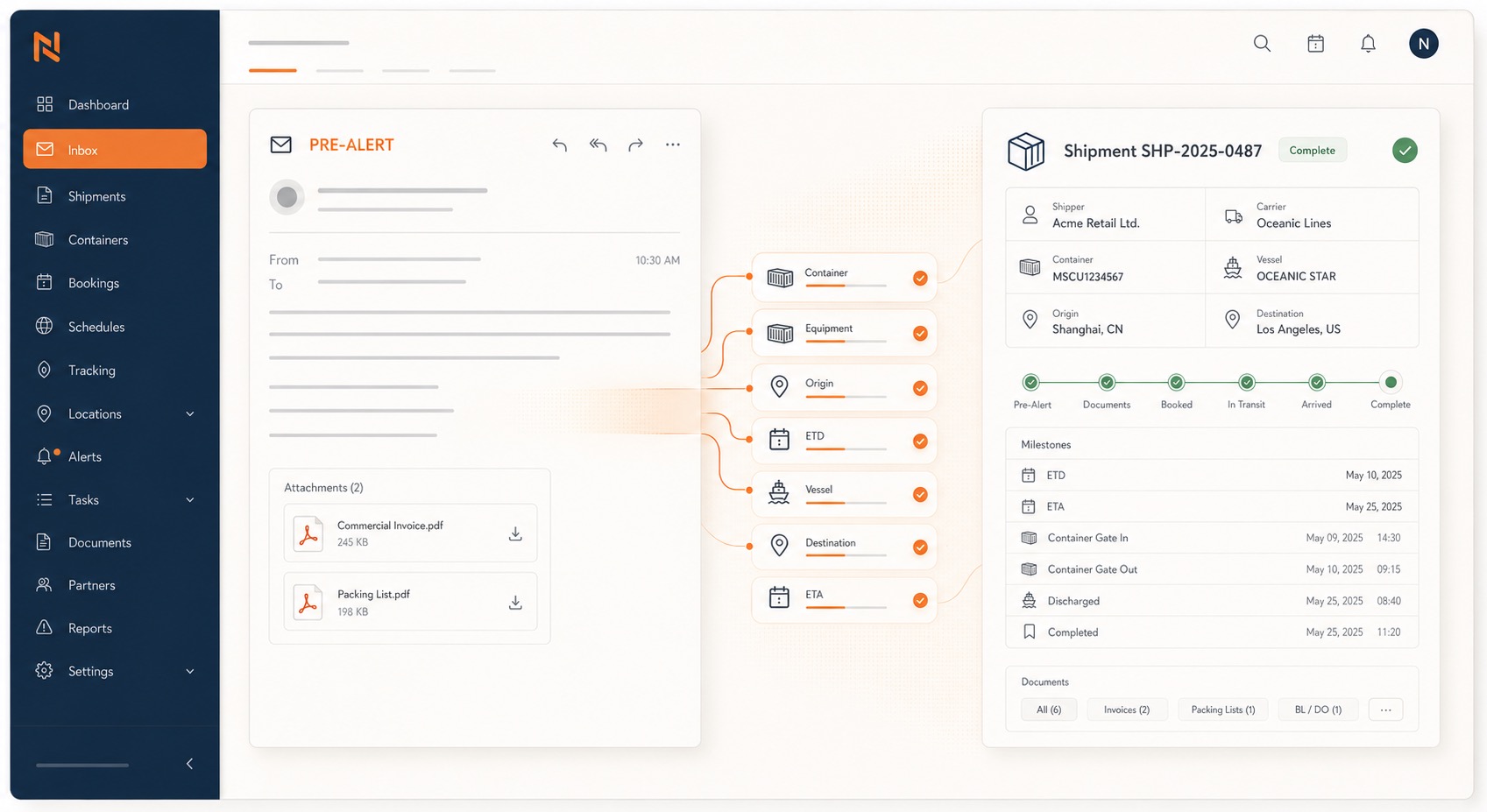
How to Automate Shipment Creation From Pre-Alert Emails
Learn how AI reads pre-alert emails and attachments, validates shipment data, creates or updates FMS records, starts tracking, and flags exceptions.
Read article →
AI Software for Freight Forwarders: What It Can Actually Automate
See what AI can automate across freight workflows, what stays under operator control, and when it should integrate with or become the core platform.
Read article →
What Is an AI Freight Operations Platform?
Learn how an AI freight operations platform connects shipment data, documents, email, and tracking to automate freight work while keeping operators in control.
Read article →
Why Traditional Freight Management Systems Still Require So Much Manual Work
Traditional freight management systems record structured data but still depend on people to interpret emails and decide the next action. See why.
Read article →
How AI Automates Container Tracking and Exception Monitoring
Learn how AI container tracking helps freight forwarders monitor ETA changes, last free day risk, and exceptions without constant portal checks.
Read article →
Human-in-the-Loop AI for Freight Forwarding: What Should Stay Under Operator Control?
Learn how human-in-the-loop AI helps freight forwarders automate routine work while keeping operators in control of exceptions, approvals, and risk.
Read article →
How AI Prepares Arrival Notices for Freight Forwarders
Learn how AI helps freight forwarders validate shipment and tracking data, prepare arrival notices, route review, and preserve an audit trail.
Read article →